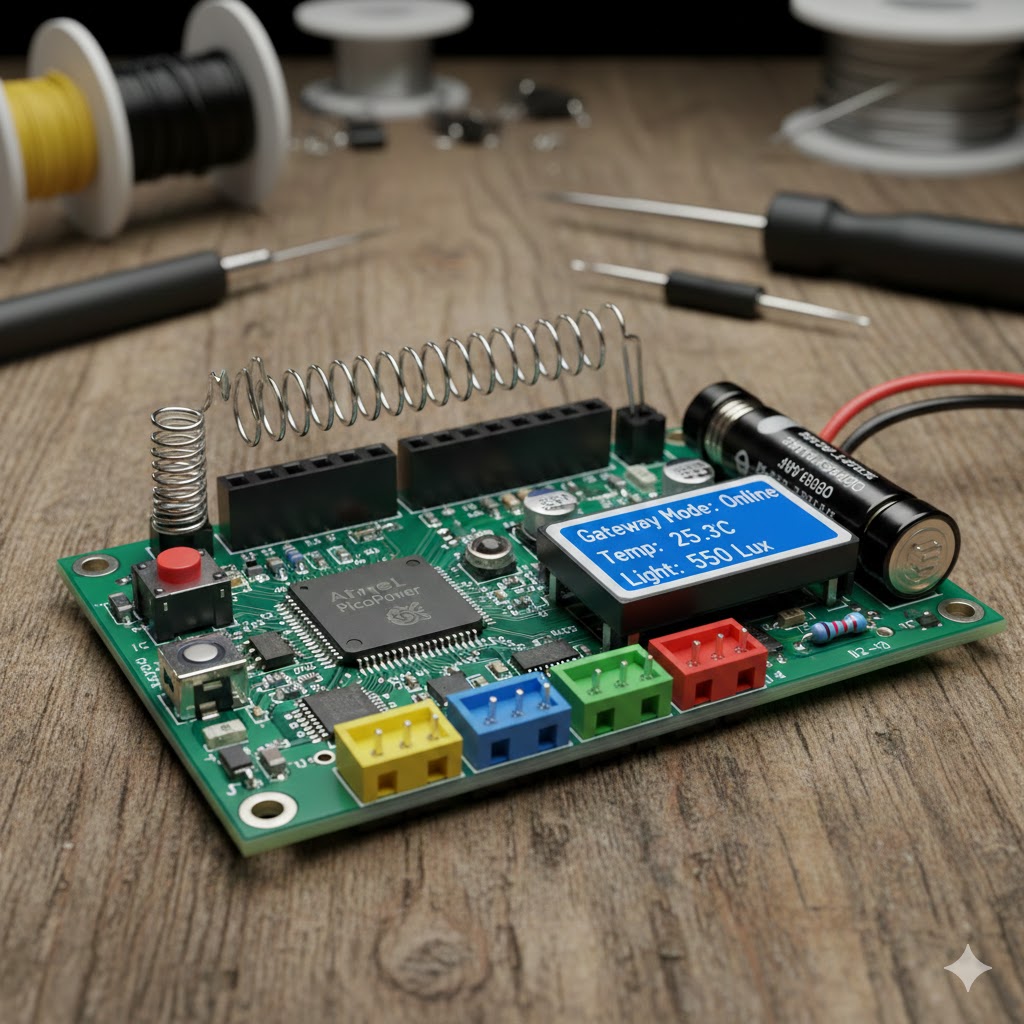
Introduction to Antennino in IoT Landscapes
In the world of IoT, where devices often rely on batteries and are deployed in hard-to-reach spots, efficiency is key. These gadgets collect and share data on environmental factors, but challenges like high energy consumption and difficult firmware updates can hinder performance. Antennino addresses these issues head-on, offering smart low power control and over-the-air (OTA) programming, making it ideal for remote sensors without the hassle of physical access.
What Makes Antennino Stand Out
Antennino is an Arduino-like circuit that’s low cost and low power, built around the Atmel chip specifically the ATmega328P with PicoPower technology. It’s fully compatible with the Arduino IDE, so developers can use familiar tools. The board integrates a communication bus, onboard sensors like the DS18B20 temperature sensor and a photoresistor, plus a wireless link through the RFM69 transceiver operating at 433MHz with hardware-level AES cryptography.
What sets it apart is its multirole capability: it can act as a remote module or a data collector (gateway). A Flash memory stores sensor data or enables wireless programming (OTA). For expandability, it includes four Groove connectors for RS232, I²C-Bus, generic I/Os, and analog inputs. An optional OLED display fits for gateway mode, enhancing usability.
Core Technical Features and Circuit Insights
The ATmega328P microcontroller is timed by a 16 MHz resonator, with a reset button and LED for notifications. Connectors allow bootloader loading and sketch uploads via Arduino IDE. The SPI bus connects the Flash memory and RFM69, while the 1-Wire bus handles the DS18B20. Analog inputs read the photoresistor, and the I²C supports the OLED display.
Power management is sophisticated. A PMOS transistor controls sensor power, and jumpers with resistive dividers monitor battery voltage via an A/D pin. Decoupling capacitors ensure stability. Certain pins are dedicated: D11-D13 for SPI, D10 for transceiver ChipSelect, D8 for Flash, D2 for interrupts, and D9 for the LED. This setup prevents conflicts but limits some I/O uses.
Innovative Low-Power Management Strategies
Antennino excels in energy saving through libraries for PicoPower modes, but it innovates with an external timer the TPL5110 chip. This digital timer, consuming just 35nA in standby, controls power via a P-MOS, allowing deep sleep from 100ms to 2 hours. It features a DONE pin for quick deactivation post-task and DELAY/M_DRV for early wake-ups from external events.
An optoisolator setup with resistors and a capacitor detects wake-up types scheduled or event-triggered via an analog pin reading. For power conversion, the MAX856 switching regulator steps up from 0.8V-3.3V inputs to 3.3V output, efficient for battery use without significant losses.
Key Highlights of Antennino’s Capabilities
Here are the main points summarizing Antennino’s features and benefits:
- Multirole Functionality: Operates as remote sensor or gateway, compatible with Arduino Uno or Raspberry Pi for data handling.
- Power Options: Supports AA batteries, 3.6-12V external, or direct 3.3V; jumpers (J1-J4) configure regulators and low power modes.
- Wireless Reliability: RFM69 ensures stable long-range communication in point-to-point or mesh networks, ideal for industrial monitoring or smart agriculture.
- Sensor Integration: Built-in DS18B20 and photoresistor, plus Groove connectors for expansion.
- OTA Updates: Enables remote firmware changes without disassembly.
- Battery Longevity: With smart sleep cycles, achieves up to 3.49 years on 2400mAh batteries, factoring in wake times and minimal idle draw.
- Security and Efficiency: AES cryptography and Watch Dog Timer alternatives via TPL5110 for ultra-low consumption.
Battery Duration and Power Source Selection
Calculating battery duration isn’t straightforward due to sleep-wake cycles. Using a formula accounting for capacity, sleep absorption (35nA from TPL5110), wake periods, and efficiency, Antennino can last years on standard AA batteries. For instance, with 2400mAh capacity, 40mA active draw, and 60-second wake intervals, it projections 3.49 years.
Power setups vary: onboard batteries with MAX856 and TPL5110, external voltage via MCP1703, or direct 3.3V. Jumper configurations ensure optimal low power management via libraries or hardware. Monitoring battery voltage via A/D helps maintain reliability, disabling unused components post-reading.
Antennino in Real-World Applications
Antennino shines in wireless projects like remote weather stations, wildlife tracking, or home automation. Its low-power Arduino with antenna design avoids stacked modules, reducing failures. Compared to traditional Arduino boards, it offers better endurance; versus ESP8266 or ESP32, it prioritizes efficiency over speed for long-range remote data transmission.
Setup is straightforward: install drivers, select board in Arduino IDE, align frequencies and IDs. Beginner ideas include wireless temperature station or soil moisture monitor, teaching sleep cycles and packet handling. Scale to multi-node sensor networks with careful channel management. Security via AES prevents casual interception.
Why Choose Antennino for Future-Proof IoT
In 2025, as IoT demands grow, Antennino’s focus on reliability and efficiency makes it essential for battery-powered IoT systems. It bridges the gap between promise and reality in wireless sensor networks, ensuring stable signals and extended life without constant intervention. For developers hating cables and valuing stability, it’s a game-changer—quiet, efficient, and built to last.
Conclusion
In a world obsessed with faster chips, brighter screens, and constant connectivity, Antennino quietly reminds us that sometimes the most valuable devices are the ones you never have to think about. It doesn’t try to do everything it does one thing exceptionally well: deliver reliable, long-range wireless data from places where power is scarce and access is difficult.
With its clever TPL5110-driven sleep architecture, built-in RFM69 radio, OTA capability, and years-long battery life on ordinary AA cells, Antennino turns the frustrating gap between “wireless promise” and “field reality” into something practical and dependable. Whether you’re monitoring soil moisture in a remote field, tracking assets in a sprawling warehouse, or building a low-maintenance home-automation backbone, this unassuming board quietly gets the job done without drama, without frequent charging, and without begging for attention.